



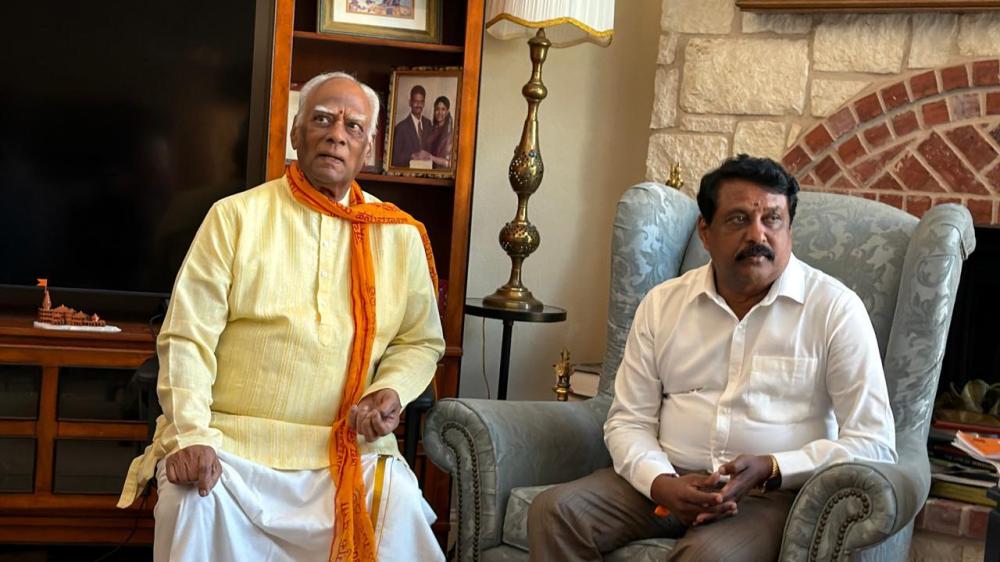
[GHHF] Sri Nainar Nagendran, President of the Tamil Nadu BJP, visited the Hanuman Temple and the GHHF office in Frisco, TX.
On October 24, Sri Nainar Nagendran visited the Karya Siddhi Hanuman Temple and later visited Dr. Prakasarao Velagapudi's residence, where he was honored.
Nainar Nagendran is a prominent political figure from Tamil Nadu and has long been with the Bharatiya Janata Party (BJP). He is the MLA for the Tirunelveli constituency and has made his mark in the legislature and in regional development. As a former minister in the Tamil Nadu government, Nagendran is well known for his contributions to infrastructure development, urban planning, and social welfare. Nagendran remains a driving force behind the BJP's expansion in Tamil Nadu's southern districts.
Born on October 16, 1960, in Vadiveeswaram, Nagendran started his career with the J Jayalalithaa-led AIADMK, serving as a member of the legislative assembly from the Tirunelveli constituency. He served as a cabinet minister from 2001 to 2006, when Jayalalithaa was chief minister, holding the portfolios of Electricity, Industry, and Transport.
Nagendran left the AIADMK to join the BJP in 2017, soon after Jayalalithaa’s death.
Nainar Nagendran served as the vice president of Tamil Nadu BJP from 2020 and won the 2021 assembly elections on the party ticket from the Tirunelveli constituency.
Dr. Prakasarao Velagapudi briefly explained the Global Hindu Heritage Foundation's 20th anniversary, its origins, and its mission. On August 23, 2006, I was reading a newspaper in Vijayawada and learned that the then Chief Minister of Andhra Pradesh, Sri Y. S. Rajasekhara Reddy, issued G. O. 21, allocating crores of rupees to build new Churches and renovate old Ones. That really shook me up. Within three days, he went to Hyderabad, found two lawyers, and got a stay order from the High Court. Then he returned to the US and, with eight other passionate, professional Hindus, started the Global Hindu Heritage Foundation.
He expressed his concern about the Hindus' apathy and indifference to Hinduism. Many Hindus do not call themselves Hindus. It appears they are ashamed of their religion. Hindus alone can undermine Hinduism. They are failing in their responsibility to protect Sanatan Dharma's richness. Every Hindu parent should take full responsibility for raising their children by imparting eternal wisdom to the next generation. Hindus have not learned the lessons of history here; they ruled us for 600 years. Our Sanatana Dharma and Bharat are being attacked every day, and we remain silent. Muslim population is increasing day by day, while the Hindu population is declining year after year.
Every Hindu should take pride in the richness of Sanatana Dharma and accept responsibility for protecting Bharat and its spiritual heritage. Our motherland faces persistent challenges from other faiths, secularists, atheists, and the liberal media. Hindus must reflect on how they are defending it, because time is running short. For the sake of humanity, every Hindu should help protect, preserve, and promote Sanatana Dharma.
Sri Nainar Nagendra briefly said he agreed with our assessment, appreciated GHHF's efforts, and thanked it for its work in Bharat. He was accompanied by more than 25 ardent followers who organized his programs in the Dallas area for two days.
{{album_1676}}
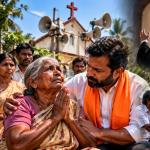






 Urgent support needed for Bangladesh Hindus


